
Express Burglaries in Santa Catalina: Why Small Bars Are So Vulnerable
Express Burglaries in Santa Catalina: Why Small Bars Are So Vulnerable
Within a few days two neighboring venues in Santa Catalina were robbed. The perpetrators acted in seconds, police arrived quickly — but the question remains: what can operators and the city do to prevent this from becoming routine?
Express Burglaries in Santa Catalina: Why Small Bars Are So Vulnerable
Two break-ins in neighboring venues within three days reveal gaps in prevention and protection
In Palma's Santa Catalina neighborhood, where the market is already setting up at half past six and the smell of coffee warms the cobblestones, two quick burglaries caused unrest in recent days. Two neighboring bars were targeted in the early morning hours: in one incident, around four o'clock, about €2,100 was taken from the day's takings and a tip jar, according to the operators in less than a minute. Police were on the scene in roughly two minutes after the alarm was raised. Three days later another bar was hit; about €700 was missing, the time of the offense around five o'clock.
The similarities are striking: both crimes occurred in the quiet period between the night shift and the start of market business, the perpetrators wore hoods and covered their hands, and the points of entry can be traced back to forced-open doors. Video recordings from the venues are available to investigators and are currently being analyzed. According to an initial assessment, it could be the same perpetrators, but secured evidence is not yet sufficient for a clear attribution.
Key question: Why are perpetrators able to strike in seconds in Palma's popular nightlife district — and what are the consequences for small business owners? That's the question being discussed now on the street, from market sellers to café servers.
Critical analysis: the cases expose several problem areas. First: the time windows. Between the end of a shift and the start of the day there is often a short phase when windows and doors are still open or only temporarily secured. It is precisely these minutes that perpetrators exploit. Second: easy loot. Cash kept in simple tills is quick to grab and presents an obvious incentive. Third: investigative gaps. Even when police respond quickly, short time spans and well-prepared offenders are often enough to disappear without a trace. And fourth: trust in investigative and judicial processes is waning — business owners report that perpetrators sometimes face few consequences after arrests.
What is missing from the public debate: discussion quickly focuses on isolated cases and sensational details. Structural questions are rarely addressed: how is night-time police presence really organized? Are there communicated routines for quickly securing bars after closing? What role do municipal lighting, waste disposal and sightlines play in prevention? And not least: how can small businesses become more secure in an affordable way, without every security measure requiring major investment?
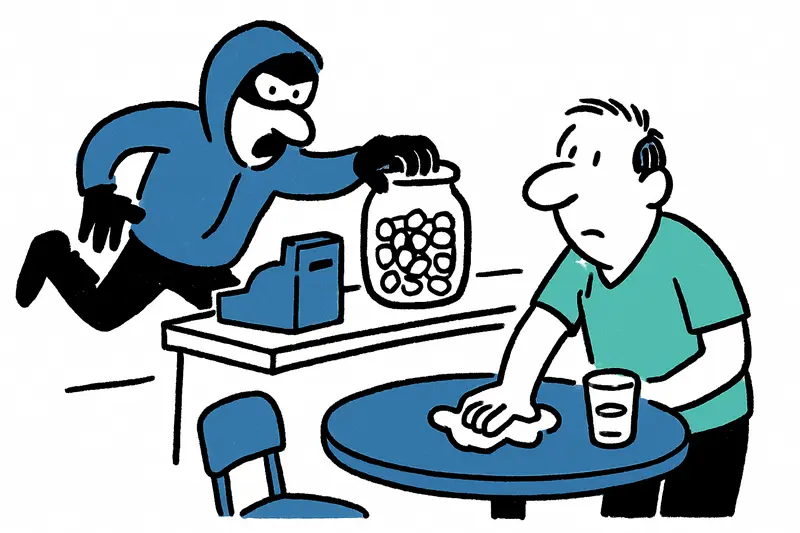
Everyday scene from Santa Catalina: in the early morning, when the Mercat de Santa Catalina sets up its stalls, the first pub owners meet in front of their venues to clean tables. A server who puts away the last glasses at five o'clock already looks cautiously into the dark side streets. A delivery driver with a pizza box honks once, a neighbor's dog barks — and it is precisely in those short moments, when people are still occupied with small tasks, that vulnerability arises.
Concrete approaches: some measures can be implemented immediately, others require political support. Practically feasible on-site are: secure cash safes for the day's takings that are only accessible during opening hours; time-delay cash box locks; alarm systems with live video forwarding to the police; good, visible exterior lighting and clear sightlines; staff training on behavior after closing (brief two-person securing, double-locking doors). At the municipal level it would be sensible to have: coordinated night patrols in hotspots, information campaigns for traders, financial support programs for safety investments by small businesses and better networking between municipal order services, police and business associations.
A sensitive point remains judicial practice: when suspects are quickly released again, frustration in the neighborhood rises. Solutions here are complex and lie with justice policy — possible measures, however, would be faster forensic analyses, more consistent use of technical evidence and closer coordination between investigative bodies and public prosecutors so that collected evidence leads more quickly to proceedings.
The neighborhood itself is reacting: residents and business owners have begun to pay more attention to suspicious people and to photograph license plates. Night shifts are sometimes ended by two people, glasses and cash registers are less often left exposed. Such small behavioral changes help in the short term but do not replace structural safeguards.
Punchy conclusion: Across Spain this may not sound like a new wave — but for the people in Santa Catalina it is. Those who earn their morning coffee do not want to constantly watch for the next break-in. A mix of practical measures, stronger presence and political follow-through on prevention funding would achieve more than outrage alone. If the city and police now do more than investigate — if they work together with owners and residents to develop practical protection concepts — the brief, costly vulnerability of small businesses in Palma can be reduced.
Read, researched, and newly interpreted for you: Source
Similar News

When Diplomacy Gets Loud: Why the Dispute Between Washington and Madrid Also Affects Mallorca
US president versus Spanish government: the clamor from Washington hits more than just Moncloa. Key question: What conse...

New Fashion Star from Colombia: Carolina Carrasquilla Brings Warmth and Presence to Mallorca
Colombian Carolina Carrasquilla (38), who lives in Santa Ponsa, has appeared on local runways and now plans to expand he...

End of an Era: Béns d'Avall Closes – What Issue Remains Unresolved?
The Michelin‑crowned Béns d'Avall is pausing after just over 50 years. Not a final farewell, say the operators – but the...

Yellow Warning over the Island: Regina Brings Mud Rain, Waves and Damp Grey
Since Thursday morning a yellow warning for heavy rain applies to all of Mallorca. The low 'Regina' is washing Saharan d...

50 Dogs from Neglected Finca Start Anew at Son Reus Shelter
At the end of February, 50 dogs were rescued from a finca near Palma. After medical care at the Son Reus shelter they ar...
More to explore
Discover more interesting content

Experience Mallorca's Best Beaches and Coves with SUP and Snorkeling

Spanish Cooking Workshop in Mallorca
