
Fourteen Boats in Two Days: When Good Weather Brings Arrivals to the Balearic Islands
Fourteen Boats in Two Days: When Good Weather Brings Arrivals to the Balearic Islands
Within 48 hours at least 14 boats carrying around 242 people landed on the coasts of the Balearic Islands. A trail of calm seas, limited coastal infrastructure and poorly coordinated aid is emerging.
Fourteen Boats in Two Days: When Good Weather Brings Arrivals to the Balearic Islands
Key question: Why does a short improvement in the weather lead to new mass arrivals — and who must act now?
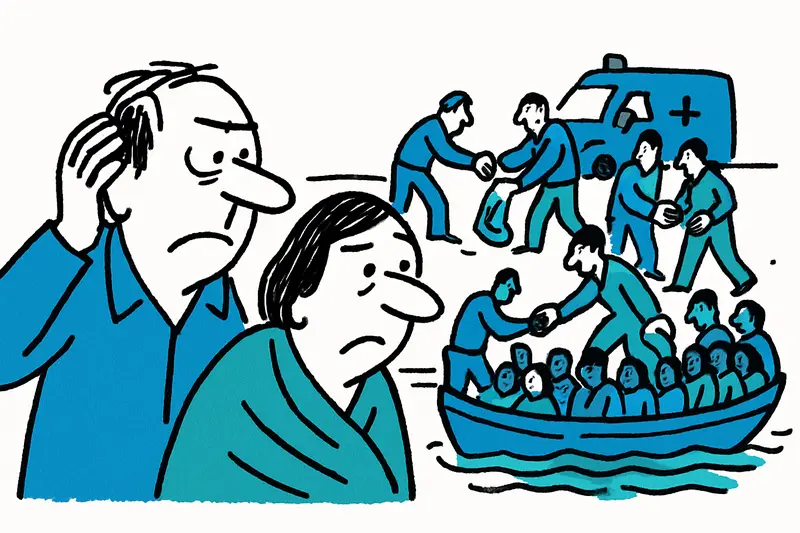
In less than two days the calm sea around the Balearic Islands washed a new wave of arrivals ashore. Official figures speak of fourteen boats and about 242 people who were brought to land or picked up at several coastal points, as happened in other concentrated arrivals such as 337 People in One Day: Between Rescue, Improvisation and Strategy. Formentera in particular experienced a strong influx: one day 57 people were registered, the next day reception centers reported 130 people in eight boats. Finds were also reported in Cabrera and Ibiza.
The images that remain in the mind are simple and striking: a small boat with a broken motor, rubber boots in the sand, a pallet of empty water bottles, the sharp smell of diesel in the air. On the promenade of La Savina locals sit wrapped in blankets, helpers carry warmer clothes to numb shoulders, ambulances emit their typical beeps. For those on board the crossing often ended with hypothermia and medical treatment.
Statistics reveal patterns that affect everyday life and politics. Since the beginning of the year official bodies have registered at least 32 boats with 567 people; other surge reports include New surge of boat migrants: 122 people rescued in one day off the Balearic Islands. A look at last year's report shows that the route from Algeria to the islands has once attracted tens of thousands of movements: in 2025 alone authorities reported 7,321 people in 401 boats from Algeria, according to More Boats, More Questions: Mallorca Under Pressure from Rising Boat Arrivals.
Critical analysis
Why does the weather so clearly affect the number of arrivals? Technically the answer is simple: calm seas and more favorable wind conditions lower the risk for smuggling logistics and make the crossing suddenly planable. Strategically the answer is more complex. The islands are geographically close, the boats often primitive, and maritime surveillance cannot be permanently present everywhere. Local emergency capacities can therefore be heavily strained in a short time.
Politically the situation reveals two problems: first, the lack of coordination at national and European levels that does not seamlessly link island protection, search and rescue, and rapid onward processing; second, the gap between short-term initial care and medium-term accommodation. The latter leads to improvised solutions in ports and communities — tents, emergency shelters, volunteers bringing blankets.
What is missing from the public discourse
There is much debate about numbers, but little about three concrete aspects: the role of local smuggling networks, proactive support for coastal municipalities, and legal alternatives for people seeking protection. Equally rarely discussed is how countries of origin and transit can be more involved without simply shifting responsibility onto them. Long-term medical and psychological care is also discussed too rarely — treating hypothermia is only the beginning for many traumatized arrivals.
Everyday scene from the island
At the port of La Savina a woman who sells tangerines at the morning market watches helpers receive a small group. The fisherman who has checked his nets for decades pauses, shakes his head and says that on a night like that even small demons believe they can tame the sea. Children watch curiously, a dog barks, tourists take photos, some look away. This is the torn everyday life: compassion and overwhelm lie close together.
Concrete solutions
The islands urgently need more staff and equipment for initial aid: mobile medical teams, warming tents and clear procedures for rapid transfers to the mainland. In the medium term surveillance must be made more comprehensive — not as a repressive measure, but to save lives: more satellite analysis, coordinated patrols and fast alert chains between search and rescue and local health services.
At the same time two political levers are important. First: expand legal access routes, such as humanitarian visas or accelerated asylum processing in cooperation with the EU, to reduce demand for risky crossings. Second: bilateral agreements with transit countries to combat criminal networks, combined with development and local opportunity programs.
Pointed conclusion
The facts are clear: calm seas bring boats, boats bring people, and they need protection, medical help and a perspective. Island councils speak of inaction by the central government; this criticism is loud, but it does not replace a functioning system. What we need is not rhetorical outrage but a practical bundle of response teams, clear procedures and political instruments that work in the long term. As long as such measures are lacking, good weather will keep bringing the next crisis.
Read, researched, and newly interpreted for you: Source
Similar News

ITV chaos in Mallorca: When re-registration immobilizes cars
Hundreds of residents are stuck: temporary plates expire, appointments for technical sign-offs are missing for months. T...

DGT and Live Warnings: What's Really at Stake in Mallorca
The Spanish traffic authority wants to curb live alerts about mobile checks. A reality check: why the idea raises more q...

Why a Tow Truck in s'Arenal Almost Escalated – a Reality Check
On Carrer Menorca in s'Arenal a routine tow operation ended with arrests: two young women (19, 22) are said to have atta...

Dolphin Surprise in S'Amarador: A Friendly Visitor on Mallorca's Coast
Dolphins were recently spotted on the beach of S'Amarador near Cala Mondragó. An Instagram video gave bathers a thrill a...
Winding up the ghost shopping center in Palma: Who benefits — the city or the owners?
The city of Palma has initiated expropriation proceedings for 25 retail premises under Plaça Major. A reality check: opp...
More to explore
Discover more interesting content

Experience Mallorca's Best Beaches and Coves with SUP and Snorkeling

Spanish Cooking Workshop in Mallorca
