
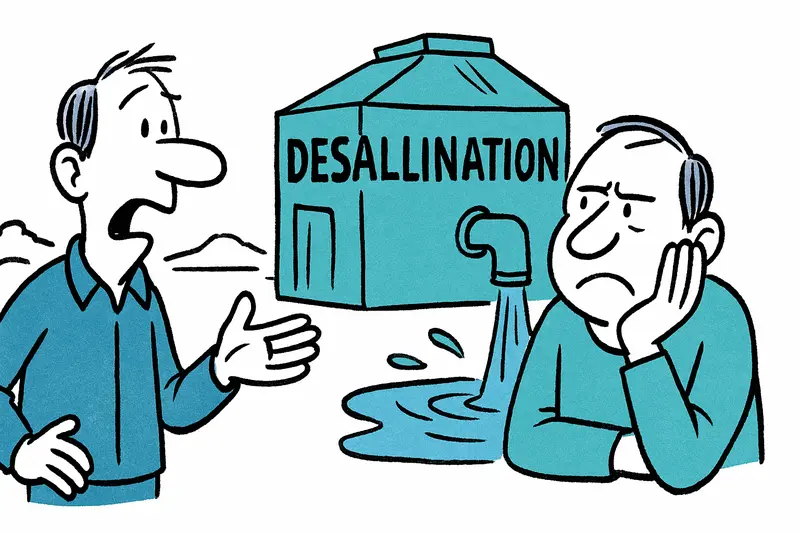
Estellencs and Water: Why a Desalination Plant Must Be Just the Beginning
Estellencs and Water: Why a Desalination Plant Must Be Just the Beginning
The municipality of Estellencs plans to build a small desalination plant — funded by the Balearic government. A necessary measure, but it raises technical, ecological and social questions. A reality-check with concrete proposals.
Estellencs and Water: Why a Desalination Plant Must Be Just the Beginning
The news is succinct: Estellencs plans a small desalination plant, the Balearic government is funding the project with just over €321,000 over three years, and test drillings near Cala Estellencs are scheduled for February to determine a site. For a municipality that has been struggling with water restrictions, especially in summer, for more than two years (see Estellencs Rations Water: 130 Liters per Person – Who Pays for the Thirst?), this sounds like relief. But is the plant really the solution to the problem?
Key question
Can a small desalination plant secure long-term supply in Estellencs without creating new problems?
Critical analysis
Desalination is technically feasible and already in use in the Balearics (for example, Alcúdia plans desalination expansion: Who pays, who really needs the water?). However, the process is energy-intensive and produces saline waste (brine) that must be disposed of. For a village like Estellencs, it is not only about the technology but about costs, supply security and environmental risks. The grant covers planning and initial steps, probably not the full investment and operating costs for decades. The risk: installing a plant and later facing high electricity bills, maintenance burdens or disposal issues, without secured long-term financing.
There is also the question of location. Test drillings near the bay can reveal important subsurface conditions, but major interventions in sensitive coastal areas have consequences for landscape and tourism. Estellencs relies on a close connection between nature, locals and visitors. A poorly placed facility can upset that balance — acoustically, visually or through construction traffic on the narrow MA-10.
What is missing in the public debate
So far the emphasis has mainly been on quick relief. Rarely is there open discussion about ongoing costs, energy needs or how waste heat and brine will be disposed of. There is also a lack of honest debate about alternatives: rainwater harvesting, repair and modernization of pipelines, smaller local water storage or a joint water network with neighboring municipalities. Also seldom addressed: demand management. How much water does a holiday home use in high summer compared with a permanent household in the village? That determines the sizing of any technical solution.
Scene from everyday life
If you drive down the MA-10 late in the morning, you see them: the shady spots at the small harbor, the fishermen mooring their boats, the tourists clambering over the rocks in flip-flops. On hot days locals stand in front of the town hall and speak quietly about the water meter, about the moment when restrictions come back into force. Children fill water bottles, gardeners scoop water, and somewhere in a side street the radio plays an old Son Mallorca tune. This is not an abstract supply problem — this is everyday life.
Concrete solutions
1) Cost and energy plan before construction: Before test drillings, it must be clarified who will operate the plant long-term and how energy for operation will be sourced. A combination of solar power and grid connection can help reduce operating costs.
2) Small storage and demand management: Investing in cisterns for rainwater at public buildings and awareness campaigns for households immediately reduce summer demand. A program to promote water-saving fittings for landlords would also be effective.
3) Regional cooperation: A network with neighboring municipalities could bring economies of scale; similar debates are visible in Water for the North: Alcúdia Relies on Desalination — Paid for by the Tourist Tax. Several small plants or a larger, centrally operated system should be compared instead of reflexively planning only a single local plant.
4) Environmental protection for the waste product: Concepts for brine dilution, controlled discharge and monitoring are mandatory. Offshore discharge is technically possible but requires solid studies to avoid harming marine habitats.
5) Transparent participation: Simple information services at the town office and public meetings before drilling begins. If residents understand the risks, costs and benefits, many conflicts can be avoided.
Conclusion
The planned desalination plant can provide important relief. But it must not stand alone. Without a detailed cost–benefit analysis, without an energy plan and without measures to reduce consumption, Estellencs risks operating an expensive technology that only treats symptoms. A better approach would be a package: efficient households, cisterns, regional coordination and desalination only where it makes ecological and economic sense. If the church bells over the bay are to keep ringing, the village needs a well-thought-out plan now — not just a quick technical fix.
Read, researched, and newly interpreted for you: Source
Similar News

Dream holiday, shattered calm: When the bank card disappears abroad
A simple scene — a card disappears into the machine, panic on the beach. Why such incidents are more than a personal mis...

Despite Renovation: Why Palma’s Paseo Marítimo Remains Empty — A Reality Check
After COVID and long construction works, venues on the Paseo Marítimo are struggling with dwindling customers, rising re...

Five Municipalities Lose Residents – Who Gets Left Behind?
Sant Llorenç des Cardassar, Escorca, Estellencs, Mancor de la Vall and Banyalbufar recorded declines. Why are small muni...
Major construction in Port d'Andratx: Who pays the price for the sewer renewal?
In the harbour of Port d'Andratx work is underway to modernize the sewage system – more than €4.1 million, heavy machine...

Cardiac Arrest on Bike Tour: What the Death near s’Aranjassa Means for Mallorca’s Cycle Routes
A 72-year-old cyclist suffered a cardiac arrest near the airport and died at the scene. The incident raises questions ab...
More to explore
Discover more interesting content

Experience Mallorca's Best Beaches and Coves with SUP and Snorkeling

Spanish Cooking Workshop in Mallorca
